
The ISP BCI at a Glance
The Idaho State Police Bureau of Criminal Identification is Idaho’s central keeper of criminal records, fingerprints, and crime statistics. BCI operates inside Idaho State Police. Idaho Code title 67, chapter 30 and IDAPA 11.10.02 establish the repository framework. State law also makes BCI the sole Idaho source that forwards applicant fingerprints to the FBI for authorized noncriminal-justice programs.
Several units support that mission. Criminal History and the Automated Biometric Identification System, known as ABIS, process arrest and civil cards and match biometric identity. The Applicant Unit handles public name and fingerprint checks. Audit and Training coordinates disposition quality with the Idaho Supreme Court and reviews criminal-justice access. Uniform Crime Reporting publishes Crime in Idaho data, while ILETS connects authorized justice agencies to Idaho and NCIC files.
The official BCI profile shows the bureau’s statewide role and operating units.
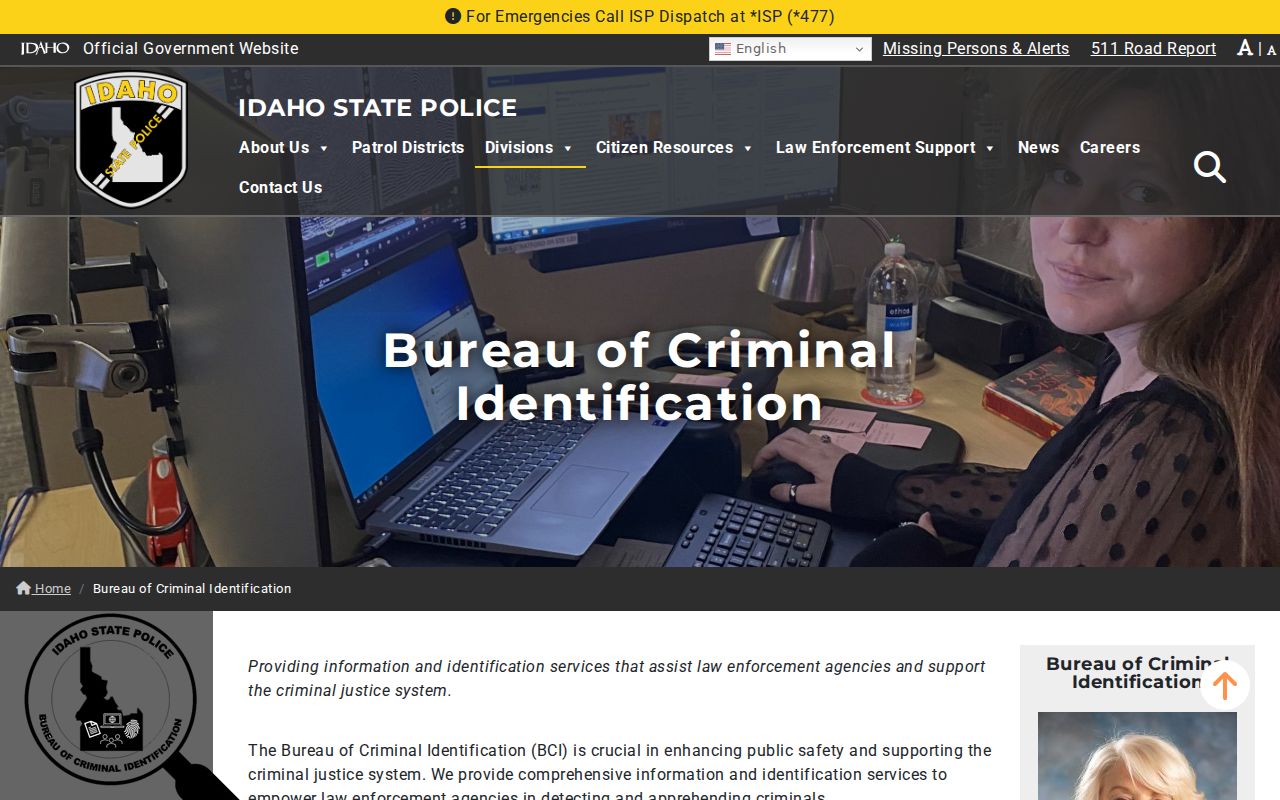
That structure explains why one bureau can support public record checks, law-enforcement identity work, audits, statistics, and the central registry.
ISP BCI ABIS and ILETS Roles
ABIS is the identity engine behind a fingerprint-supported Idaho criminal record. It lets BCI compare prints and join new arrest events to the correct state identity. It also supports palm-print and image standards. Livescan submissions speed the flow, but BCI still accepts cards. The technology has changed over time without erasing the need for a valid originating report and a matching court outcome.
ILETS serves a different function. It is Idaho’s secure criminal-justice communications network and state control-terminal link to NCIC. Wanted persons, protection orders, missing persons, property records, and restricted criminal-history data move through that authorized network. ILETS is not a public name-search site. An ordinary public user orders a BCI product or uses a separate public system such as iCourt.
BCI also manages the central Idaho sex offender registry, while county sheriffs register and verify people locally. That public notification file is separate from a repository rap sheet. Its current status and search tools belong in the Idaho sex offender lookup, not in a name-based BCI check.
What Checks Idaho State Police BCI Offers
ISP BCI offers a $20 Name-Based Criminal Background Check and a $25 Fingerprint Based Criminal Background Check. Both cover the Idaho Central Repository, not every state or federal record. The name product can be requested by any person, but spelling, aliases, and false birth dates can lead to weak matches. It cannot be notarized. A fingerprint check establishes positive identity and can be notarized when requested.
Without a recent signed waiver, BCI cannot disclose to a noncriminal-justice recipient an arrest more than 12 months old when no disposition is present. A waiver must be signed within 180 days. That rule limits disclosure; it does not mean BCI deleted the arrest. For one’s own record, fingerprints are the strongest way to see which Idaho events BCI linked to the identity.
| Product | Who May Order | What It Returns | Cost |
|---|---|---|---|
| Name-Based Criminal Background Check | Any requester using the official form | Possible Idaho name match; not positive identification | $20 |
| Fingerprint Based Criminal Background Check | The subject or an authorized requester | Positive-ID Idaho repository record; notarization available | $25 |
| BCI fingerprint rolling | Anyone needing an inked applicant card | A completed card returned for submission | $10 first card; $5 each additional |
| NCPA Idaho and FBI check | BCI-approved qualified entity under the program | Authorized state and national response | $37 covered employee; $35 volunteer |
| Record challenge comparison | Person disputing their own BCI result | Identity comparison and correction review | Fingerprint check is free for the challenge |
The current BCI product and fingerprint page provides the forms, prices, and submission rules.
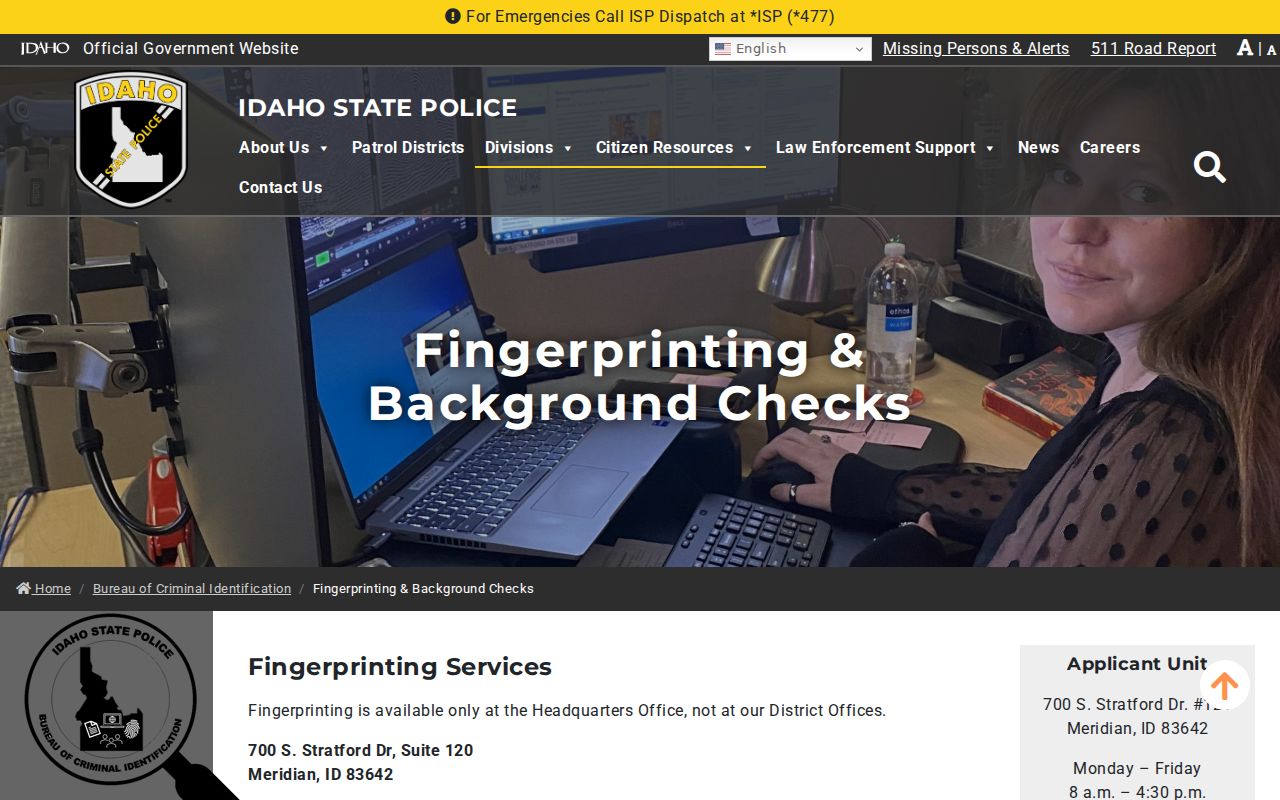
The page confirms that Idaho’s public check is a document workflow, not a browser search.
Why ISP BCI Has No Instant Portal
A public Idaho State Police BCI check begins with a form and payment. BCI does not offer an instant web name lookup. It also does not accept check requests by email or return results by telephone, fax, or email. A name request may be faxed when the current form allows, but the result is still mailed. Mail and hand delivery work for both public products.
This slower route is not the same as iCourt. The court portal can quickly show public case information from all counties. It cannot certify a repository rap sheet. BCI, by contrast, compiles fingerprint-backed Idaho arrest cycles and reported dispositions. A quick court search may be useful while waiting, but one system never turns into the other.
Key distinction. Idaho iCourt answers what happened in a court case. ISP BCI answers which fingerprint-supported Idaho events reached the central repository.
The Path Into the ISP BCI Repository
An Idaho record starts with the local agency. Police or a sheriff creates the arrest report. A jail creates the booking entry and takes prints for a qualifying custodial arrest. The card moves to ISP BCI by livescan or on paper. ABIS compares identity and creates or updates the person’s Idaho record. Prosecutors, judges, and clerks later supply disposition information that BCI tries to link to the arrest cycle.
Data flow: County Arrest › Fingerprint Submission › Idaho State Police BCI › Court Disposition Reporting › Rap Sheet
If the arrest card never reaches BCI, the event may remain in a local police or jail file without appearing in the central history. A disposition can also lag or fail to match. BCI’s audit staff works with the Idaho Supreme Court on timely and accurate outcomes, but no current official statewide completeness percentage was found. Use the county directory when the original arrest, booking, or court file is needed.
How ISP BCI Audits Dispositions
The Criminal History Records Information auditor coordinates with the court system to find late or incomplete dispositions. The UCR auditor helps law-enforcement agencies submit crime data, and ILETS or CJIS staff audit secure system access. This work improves quality but cannot create a disposition that the originating court or agency never reported.
The ISP BCI Audit and Training page identifies these statewide review roles.
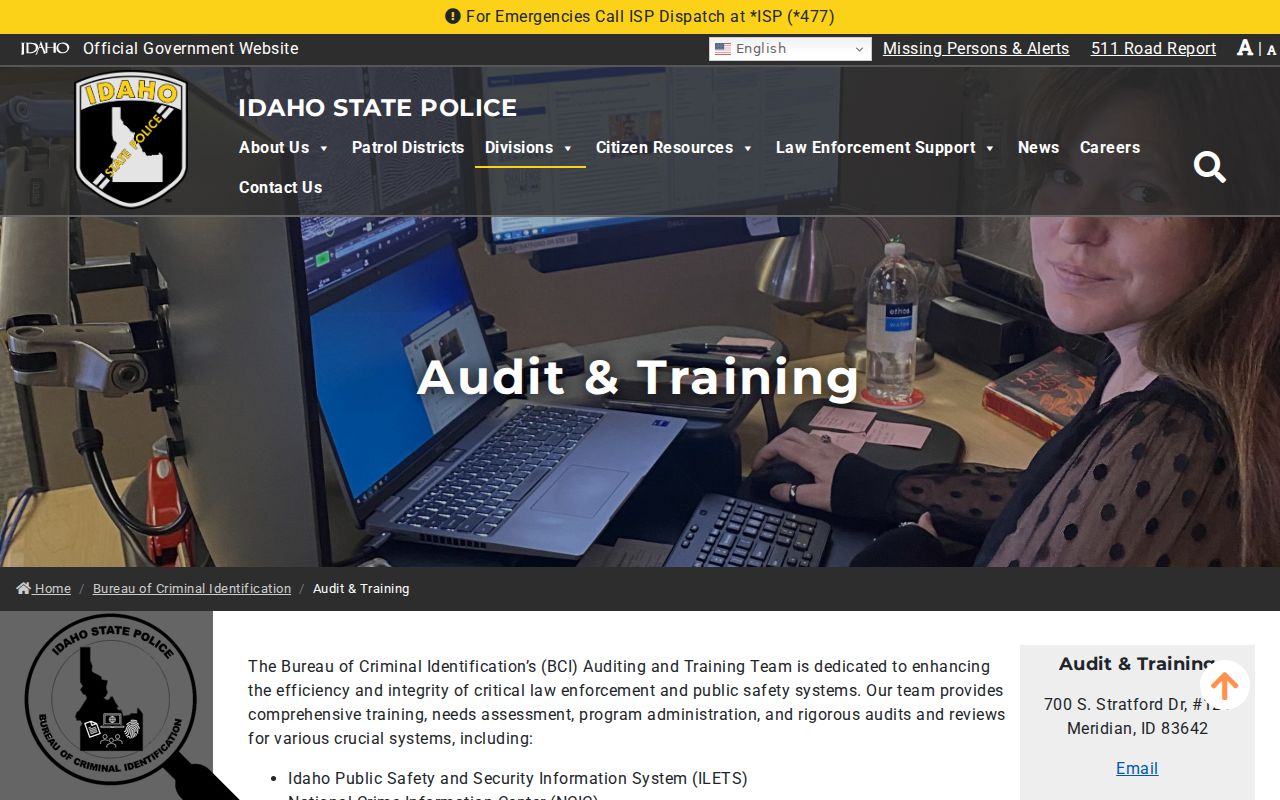
The audit function is the bridge between local source records and a more complete statewide rap sheet.
Note: A missing Idaho BCI disposition calls for a county court check, not an assumption that the case is still pending.
ISP BCI Check Ordering Steps
Choose the product by the answer needed. A name check can find a possible Idaho repository match. Fingerprints are better for reviewing one’s own record because they establish identity. Download the current request and Payment Authorization forms from BCI. Card payments add $1 plus 2.5 percent. A returned check can add $20.
- Select the name-based or fingerprint-based Idaho check. Use fingerprints for the strongest personal review.
- Complete all names, aliases, birth and return-address fields. Add a waiver only if it is current and appropriate.
- For a fingerprint check, obtain a complete applicant card signed and dated by the printer within 180 days.
- Mail or hand deliver the packet and payment. Follow the current form if faxing a name request.
- Read the mailed result by arrest cycle, then obtain the county judgment when an outcome needs proof.
BCI headquarters in Meridian rolls prints without an appointment for $10 on the first card and $5 for each added card. Outside the Treasure Valley, contact a local law-enforcement agency and confirm its hours and price. Idaho has no verified single retail fingerprint vendor network for this public product.
ISP BCI Forms and Submission Channels
The name form asks for the record subject’s names, aliases, date of birth, descriptive data, requester information, mailing address, reason, and optional waiver. The separate Payment Authorization holds card details. The fingerprint workflow adds an applicant card with identity data, signature, printing official, date, and reason fingerprinted. A notarized-result box is available on the fingerprint request.
The ISP BCI forms library is the safest source for the current version.
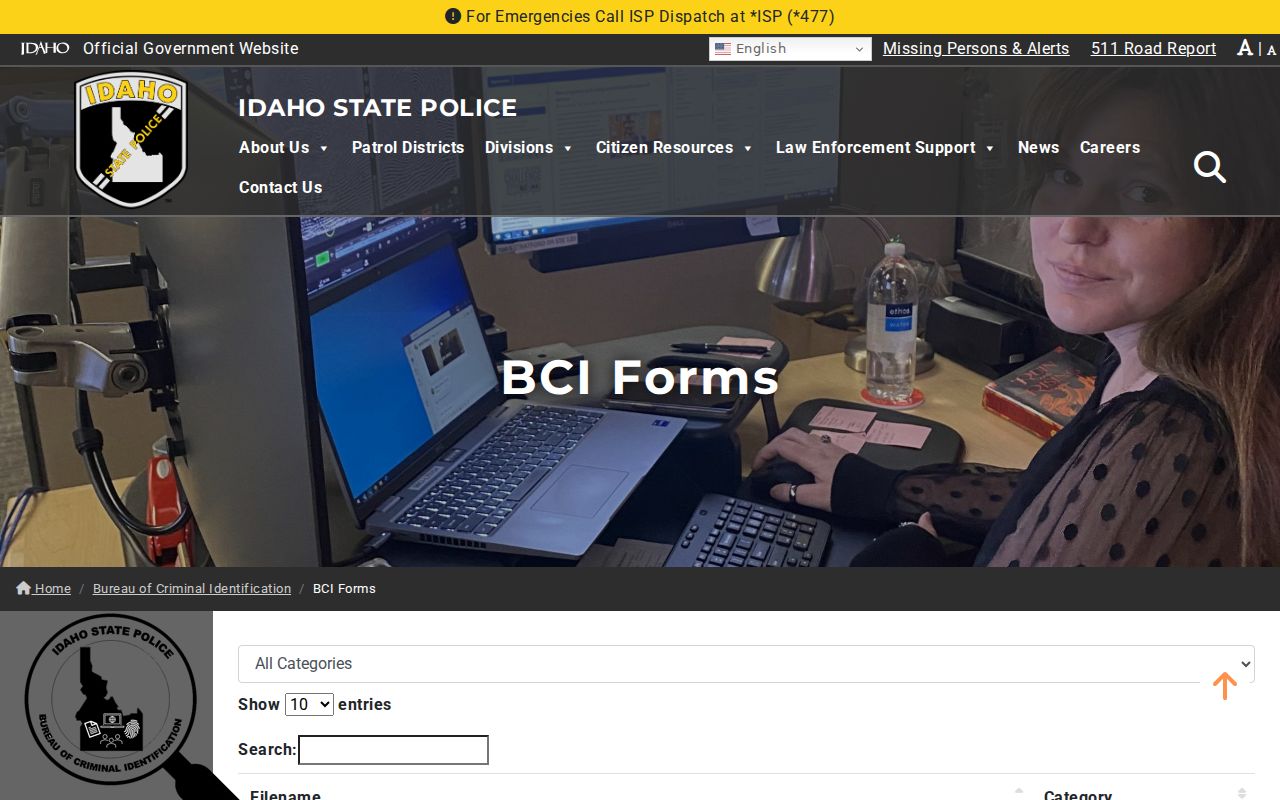
Using the current file helps avoid a returned packet caused by an old field or payment instruction.
BCI works first come, first served and publishes no fixed turnaround for ordinary public checks. Results travel by mail. Poor prints can be rejected. Under the documented workflow, a first poor-quality rejection may be resubmitted with the rejection papers without a new fee.
Comparing ISP BCI and County Records
An ISP BCI check gives one statewide Idaho compilation. A county file gives the source material for one event. The BCI report can connect fingerprint-supported arrests from many Idaho counties, while a clerk can produce the complaint, orders, judgment, and certified disposition. A sheriff or police agency keeps its narrative and related evidence records. Neither replaces the other.
| ISP BCI Check | County Records | |
|---|---|---|
| Coverage | Reported Idaho events across 44 counties | One filing or creating county |
| Source | Fingerprint-supported repository cycles | Original court, jail, sheriff, or police files |
| Freshness | Depends on fingerprint and disposition reporting | Updated as the local case or custody event moves |
| Detail | Identity, arrest charges, and submitted outcomes | Narratives, docket events, orders, and certified copies |
| Best use | Statewide personal history review | Proving or understanding one event |
A BCI dismissal stays visible with that result unless a legal remedy removes it. A court docket may show a later event before the repository does. Search Idaho court cases and ask the filing clerk for certified proof when the two sources differ.
What ISP BCI Leaves Outside Idaho
The ordinary ISP BCI report covers Idaho arrests that were supported by submitted fingerprints and the dispositions BCI received. It does not pull in other states, federal convictions, or Idaho arrests with no submitted card. Ordinary juvenile matters are excluded unless handled as adult cases. Sealed, shielded, expunged, and exempt data follows the controlling access rules.
For a subject’s nationwide FBI-maintained history, the person can order an FBI Identity History Summary through the FBI’s electronic or mail route. The direct federal fee is $18, plus any fingerprint or approved-channeler charge. That record is also not a county case-file archive. A federal Idaho docket belongs in PACER, while a state judgment belongs with the Idaho filing clerk.
ISP BCI Criminal Check Fee Change
ISP announced that the fingerprint-based Idaho check increased from $20 to $25 on January 1, 2026. The ordinary name check stayed at $20. NCPA state and national fees became $37 for the covered employee category and $35 for the volunteer category. ISP said Idaho processes more than 90,000 fingerprint cards each year, plus thousands of name checks.
The price change did not create an instant portal. Forms, prints where required, payment, delivery, and mailed results still control. Check the current BCI page before sending funds because statutory program prices differ and local agencies set their own fingerprint-rolling charges.
ISP BCI Record Error Corrections
Review begins with one’s own fingerprint-based record. Read the identity segment and every arrest cycle. Compare the arresting agency, arrest date, charge, and disposition with the official BCI criminal-history guidance. Common issues include a missing court outcome, a mismatch, or an entry that should reflect an authorized order.
The repository correction and relief page presents the official challenge route.
The central lesson is that BCI needs reliable proof from the agency or court that created the disputed fact.
- Order the fingerprint-based Idaho record. BCI says the comparison check is free when used to challenge accuracy.
- Compare each line with the originating agency record and the filing county’s certified disposition.
- Send BCI the supporting material. BCI corrects at the originating agency’s direction or under an appropriate court order.
- Order or review a fresh result after correction. A change in iCourt does not prove every repository copy changed at once.
BCI expungement under Idaho Code §67-3004(10) is limited to qualifying nonfiled, fully acquitted, or fully dismissed arrest events. Clean Slate shielding is a different court-filed remedy for eligible completed cases after five years. Withheld-judgment relief and juvenile expungement are separate again. Idaho does not have one universal erase command.