
How Idaho Courts Handle Criminal Cases
Idaho uses one unified court system. Each county is served by a District Court that includes a Magistrate Division. Magistrates handle infractions, misdemeanor trials and sentences, warrants, bail, initial felony appearances, and preliminary examinations. A felony that survives the early stage moves to a District judge for trial and sentence. Appeals from a magistrate first go to District Court. Felony appeals can proceed to the Idaho Supreme Court, with the Court of Appeals hearing matters assigned to it.
The elected Idaho clerk of the district court in the filing county keeps both magistrate and district case files. Idaho does not send city misdemeanors into a separate municipal-court network. That makes the Idaho court map more consistent, but a single Idaho felony can still show early magistrate events and later District Court events. The Idaho Judicial Branch court overview illustrates this shared structure.
The same official Idaho court overview is shown in this structure capture.
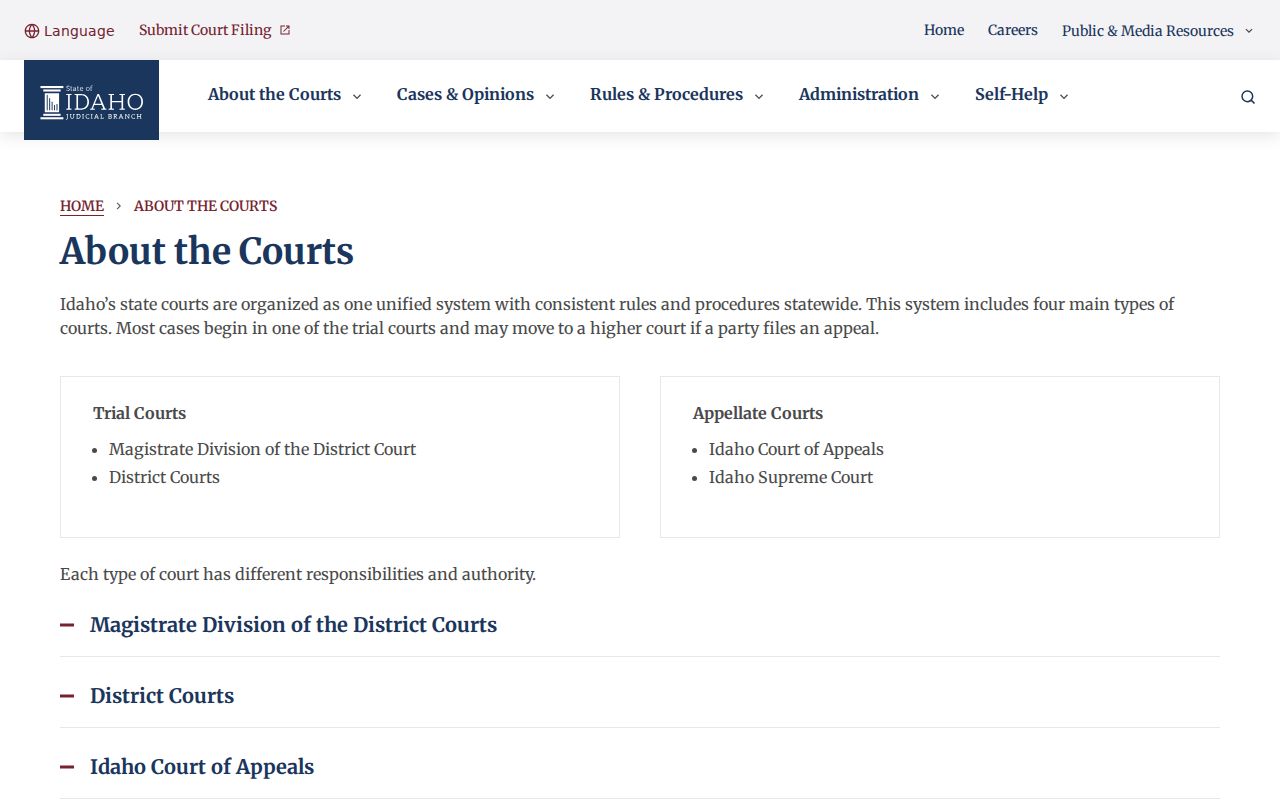
That Idaho hierarchy helps a searcher decide whether an entry belongs to an Idaho misdemeanor case, an early felony stage, a felony trial, or an appeal.
Idaho Felony Court Record Path
An Idaho felony commonly starts with an arrest, citation, summons, or complaint. A magistrate addresses the charge, rights, counsel, and bail. Unless a grand jury has returned an indictment, the complaint proceeds to a preliminary hearing or waiver. A finding of probable cause sends the matter onward. The prosecutor then files an information, or a grand jury supplies an indictment, and a District Court arraignment produces the plea.
Complaint, information, and indictment are not Idaho synonyms. A complaint starts many Idaho criminal proceedings. An information is the prosecutor's felony charging document, often filed after the preliminary stage. An indictment is returned by an Idaho grand jury. Grand-jury proceedings remain secret, though an unsealed indictment may enter the public Idaho case file. Knowing the document name makes a clerk request narrower and more useful.
Note: One Idaho felony may display both magistrate and district events without representing two unrelated prosecutions.
Running an Idaho iCourt Portal Search
The Idaho iCourt Portal covers public basic case information from all 44 counties. It is the fastest first check for a filed Idaho case. It is not a certified Idaho file, an arrest narrative, or a full repository history. Same-name results need careful comparison. Sealed, exempt, juvenile, and protected details do not appear, and Idaho document access can vary by account and portal generation.
- Open iCourt and use the case number when known.
- For a name search, enter the party name and compare court, charge, dates, and any public identifying detail.
- Narrow results with status, date, type, location, or party filters when those controls are offered.
- Open the register of actions and read each charge's events and disposition, not just the overall case status.
- Ask the filing county clerk for a named document, older file, plain copy, or certified copy.
| Field Label | Type | Required | Use |
|---|---|---|---|
| Smart Search | Text | One identifier | Accepts a case number or party or business name. |
| Case Number | Text | Alternative | Best unique key; formats vary by county and court. |
| Party Name | Text | Alternative | A name match alone does not confirm identity. |
| Advanced Filters | Expandable | No | May include status, dates, case type, location, and party type. |
| Location or County | Dropdown | No | Narrows the statewide result set to a filing location. |
Idaho Court Portal Changes
Odyssey reached every Idaho county after a transition that began around 2016. The Judicial Branch launched an Attorney of Record Portal in early 2025 and expected revamped public and extended-access portals in 2026 because the former vendor was ending support. The basic research method remains stable: search public case data first, then confirm filed documents with the custodian. Control labels and document functions may shift as the replacement rolls out.
Searchers should not mistake a changed button or missing download link for a deleted Idaho case. Confirm the Idaho case number, check current Judicial Branch instructions, and use the courthouse kiosk or clerk. An April 2026 website relaunch also changed how users reach Idaho forms, rules, cases, and court data. Official published contact details are safer than links in unsolicited messages, especially after Idaho warned about fake court texts and a fictitious “Idaho Supreme Court Repository.”
What an Idaho Case File Contains
A public Idaho case record joins Idaho identifiers with a dated register of actions. Read at charge level. One Idaho case can contain several counts, and each count may have a different outcome. The header often provides the Idaho case number, filing date, case type, court location, judge, and status. Party and attorney information may appear, while birth data and other personal identifiers are restricted or shortened.
| Case Number & Court | Identifies the proceeding, filing location, court division, and judicial officer. |
|---|---|
| Charging Documents | Complaint, information, or indictment states the filed allegations and cited law. |
| Register of Actions | Lists filings, hearings, warrants, pleas, orders, trial settings, judgment, and appeal events. |
| Charge Detail | Shows description, statute, level, offense date, amendments, and disposition when public. |
| Disposition | Records the outcome of each charge, such as conviction, dismissal, or acquittal. |
| Sentence & Judgment | May show incarceration, probation, fines, restitution, and the entered judgment. |
The Idaho Criminal Rules provide the procedural source behind many docket events.
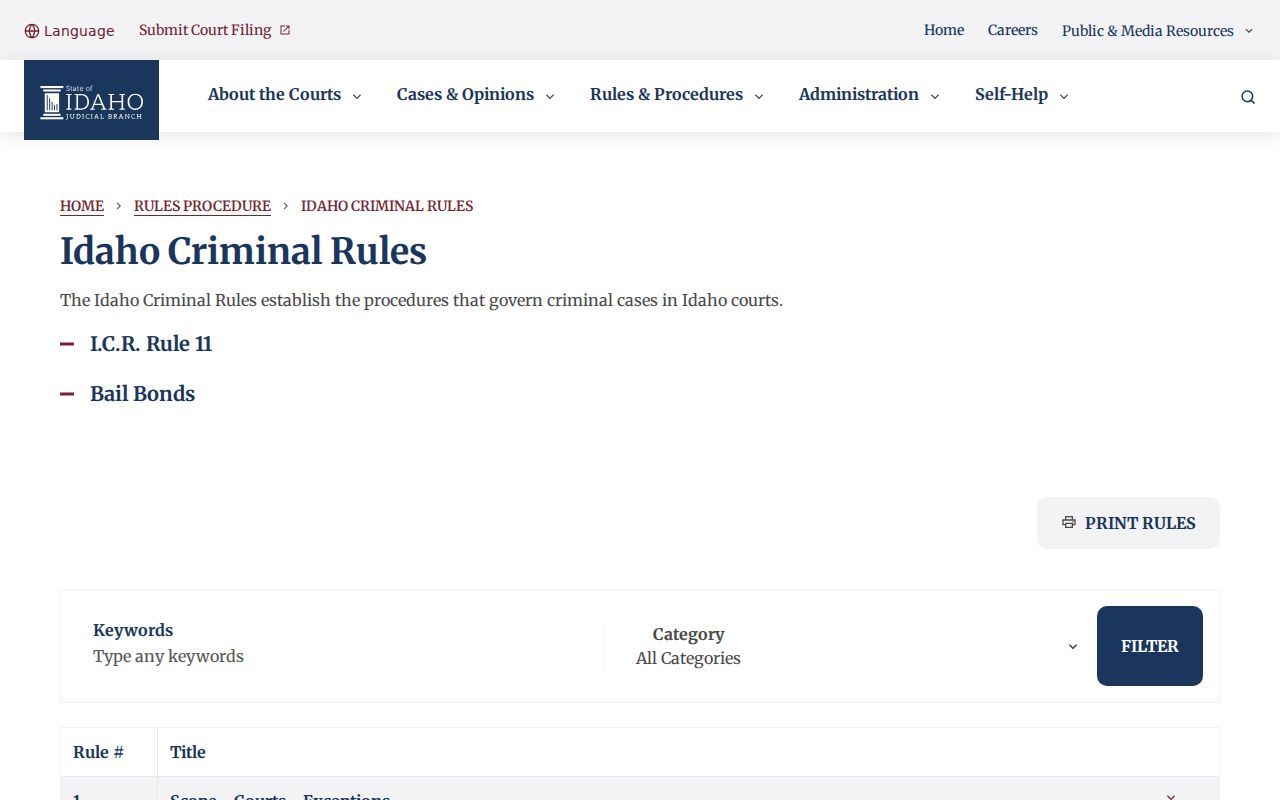
The rules supply context for the short event labels found in an Idaho register of actions.
Idaho Court Record Access Limits
Idaho Court Administrative Rule 32 governs judicial records. It is distinct from the Idaho Public Records Act used for executive-branch agency records. Court records are broadly open, but presentence reports, sealed filings, protected juvenile matters, victim or minor details, Social Security numbers, full account numbers, and other protected information may be withheld or redacted. A redaction removes a protected field while leaving the rest available. A sealed record is closed under a rule or order.
The official Idaho Court Administrative Rules are the source for those access boundaries.
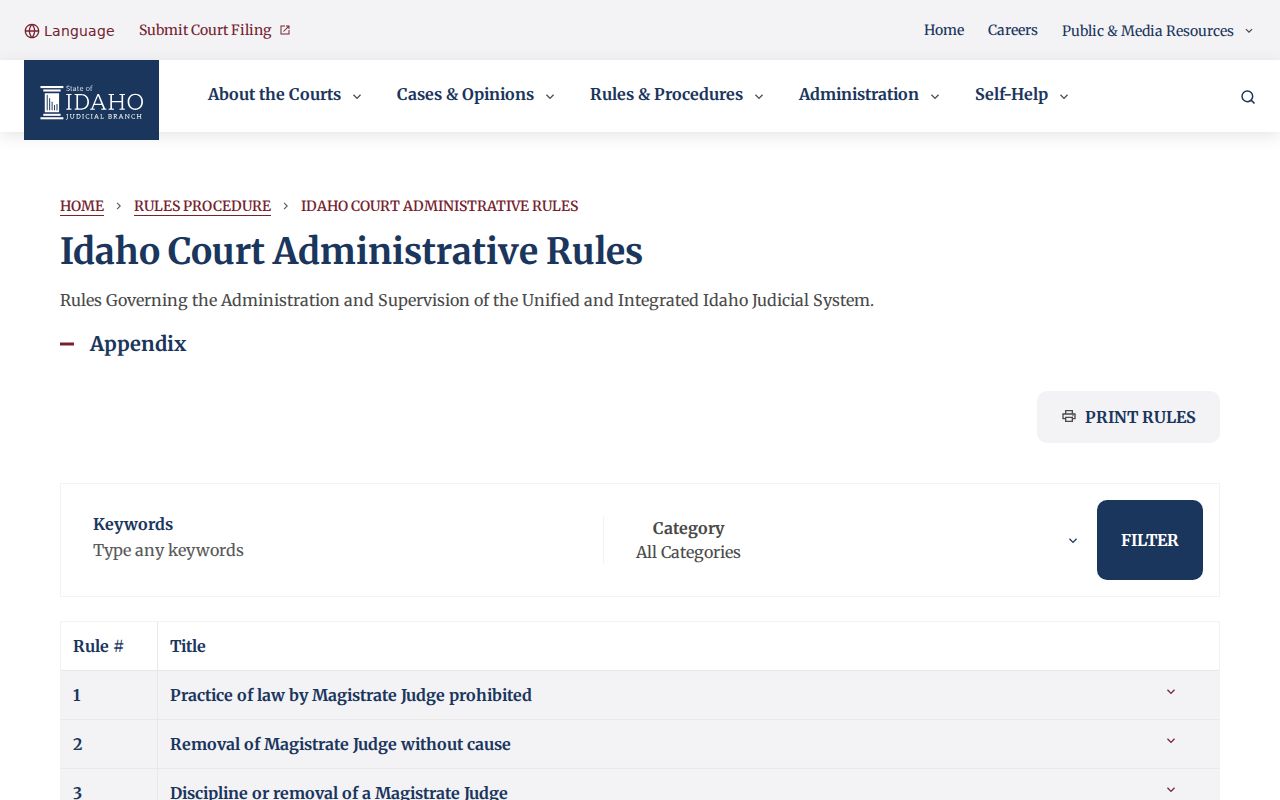
Those Idaho rules explain why a public Idaho docket may exist even when a document or sensitive field is not available online.
Idaho Criminal Case Stages
Each Idaho stage creates a different court record. An Idaho complaint, information, or indictment states charges. Arraignment records a plea. Motions and discovery disputes create filings and orders. A negotiated plea or trial leads to an outcome. An Idaho judgment and sentence set the legal result. Postjudgment motions or an appeal can add later entries, while probation violations can reopen activity after the main judgment.
Case flow: Charges Filed › Arraignment › Pretrial › Plea or Trial › Disposition › Sentencing
Case status and charge disposition must be read apart. “Open” may reflect an unresolved count or later activity. “Dismissed” ends the charge but does not erase the arrest event from the Idaho State Police BCI record. A withheld judgment is an Idaho relief posture under a court order, not automatic BCI expungement. If the wording is unclear, obtain the actual order.
Idaho State and Federal Cases
Idaho iCourt does not include federal criminal cases. The U.S. District Court for the District of Idaho is one federal district with several divisional court locations. Its public criminal dockets use PACER, which requires registration and can charge by the page. Public entries can identify the case, judge, parties, filing dates, docket text, judgments, and unsealed documents. Sealed filings, protected identifiers, and grand-jury material remain unavailable.
A federal matter also does not enter the ordinary Idaho-only BCI report merely because an arrest occurred in Idaho. A local arrest later adopted for federal prosecution can leave both an agency record and a separate federal docket. Use iCourt for Idaho state cases, PACER for federal cases, and the relevant clerk for an authenticated copy. The official District of Idaho site supplies federal court contacts and filing information.
Idaho Docket or Certified Record
Online iCourt viewing is an Idaho discovery tool. It answers whether a public Idaho case exists, where it was filed, and what the register shows. An Idaho courthouse kiosk offers the Judicial Branch's stated no-login access route for public case information. A plain clerk copy reproduces a filed document. A certified copy adds the Idaho clerk's authentication. These channels serve different needs.
The Judicial Branch describes the portal, kiosk, and clerk access channels in its record guidance.
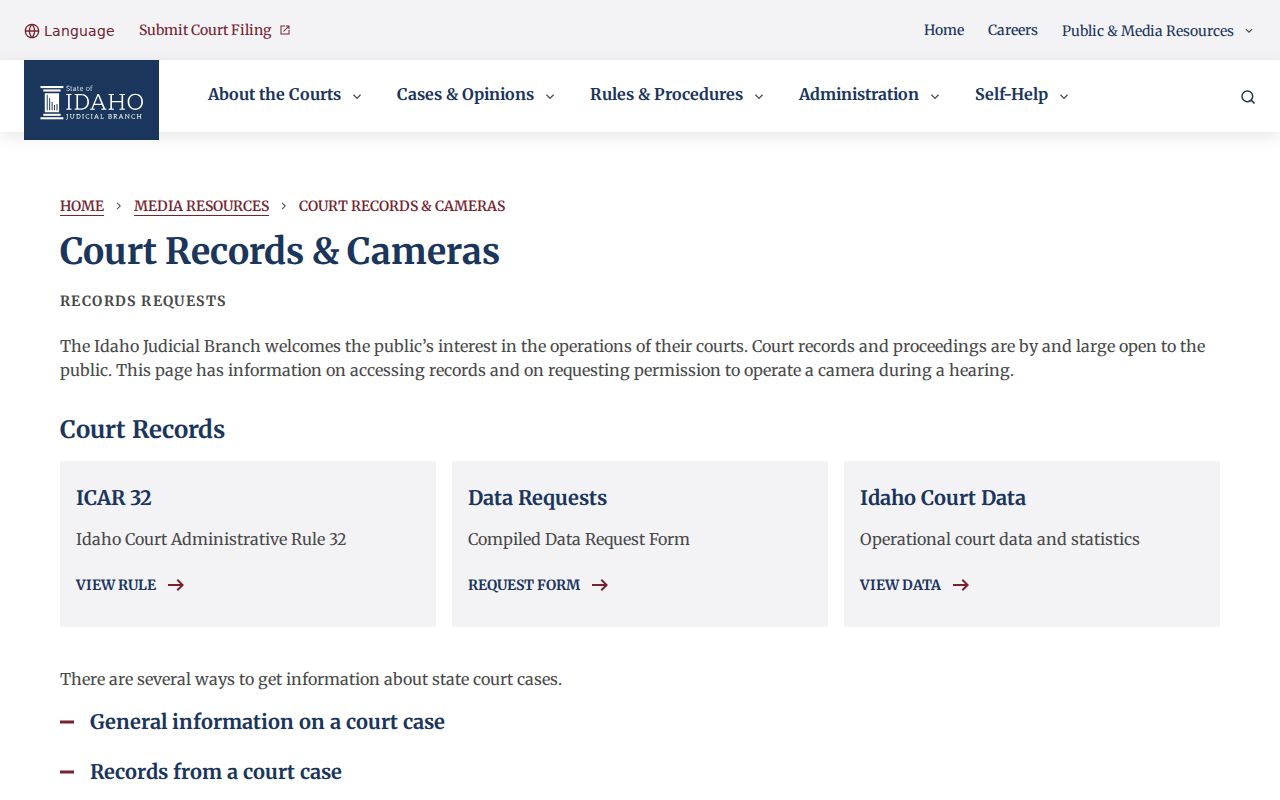
The channel split matters most when an Idaho case has no downloadable image or needs official certification.
Ask for a specific complaint, judgment, dismissal, sentencing order, or register of actions. Include the case number. Older paper files and archived exhibits can take retrieval time, and clerk search, copy, or certification charges can vary. Bulk or compiled court data is a separate ICAR 32 process, not an alternative individual-name search.
Idaho Case Files and Rap Sheets
An Idaho county court file and an ISP BCI rap sheet answer different questions. The Idaho court file documents one judicial proceeding. It contains the official filed charge, docket, orders, outcome, and sentence. The BCI record compiles fingerprint-supported Idaho arrest cycles and dispositions that agencies reported to the repository. It is not an Idaho case-document archive, and it excludes other-state and federal matters.
A missing BCI disposition does not prove the Idaho court case remains pending. The outcome may not yet have reached or matched the fingerprint cycle. Search iCourt, obtain a certified disposition from the filing clerk, and use that proof when challenging one's own BCI record. Likewise, a court docket does not replace the officer's incident report or a jail booking record. Each comes from a separate custodian.
- Disposition
- The outcome of a charge, such as conviction, dismissal, or acquittal.
- Register of actions
- The dated list of filings, hearings, orders, and case events.
- Rap sheet
- The chronological repository history compiled by ISP BCI from reported events.
- Withheld judgment
- An Idaho court disposition that can support later relief after conditions are met.
County Sources for Idaho Case Records
The complete Idaho court file stays with the elected clerk in the county where the matter was filed. The official county courthouse directory identifies that local route.
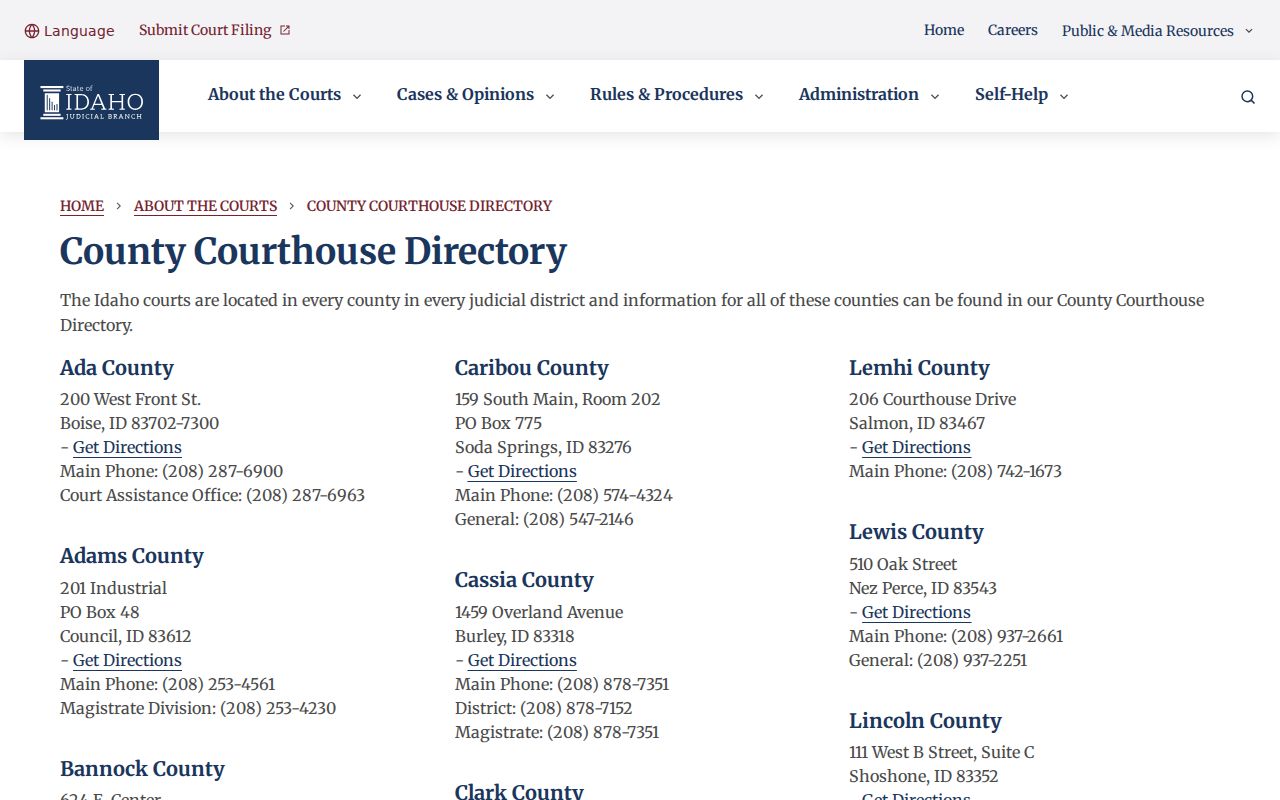
The directory connects a statewide iCourt result to the office that can inspect, copy, or certify the underlying Idaho case record.
Start with the case number and document name. Ask whether the file is electronic, archived, sealed in part, or available at a kiosk. The clerk can explain access and fees but cannot give legal advice. For an arrest narrative, contact the agency that created the report. For current custody, use the county jail. Browse the full directory of all 44 Idaho counties to reach the right local criminal records site.