
Arrest Records Across Idaho
An Idaho arrest can produce four distinct records. The officer's agency creates an incident or arrest report. A county jail creates booking and custody data for a custodial arrest. ISP BCI may create a fingerprint-supported repository cycle. The court creates a case after a complaint, information, or indictment is filed. Each record has its own custodian, update pace, and access rule.
Idaho county deputies handle county duties, warrants, and jail operations. Idaho city police or marshals keep reports made within their jurisdiction. Idaho State Police creates highway and statewide-investigation records. Idaho tribal, campus, and other authorized police retain records within their legal scope. Contact the exact Idaho agency that wrote the report. A broad request to “the county” may reach the wrong office, and ISP cannot supply a city or sheriff report.
Four Idaho Arrest Record Sources
The Idaho report, booking, repository cycle, and court docket can disagree without any one source being false. An Idaho booking can disappear from a current jail roster after release. An Idaho arrest can remain local if fingerprints never reach BCI. An Idaho court disposition can post before it is matched to the repository event. The iCourt docket also omits the Idaho officer's full narrative. Read each source for the job it performs.
| Source | Best Use | Main Limit |
|---|---|---|
| Arresting agency | Incident narrative, evidence references, and officer action | Agency-specific and subject to redaction |
| County jail | Recent booking, hold, bond, housing, or release data | Not statewide and often short-lived |
| ISP BCI | Fingerprint-supported Idaho arrest cycles and reported outcomes | No unsubmitted prints, other states, or federal cases |
| iCourt and clerk | Filed charges, docket events, dispositions, and judgments | Not the arrest report or booking record |
Note: A missing entry in one Idaho arrest system should prompt a second source check, not a firm conclusion.
From Idaho Arrest to Rap Sheet
An Idaho custodial arrest usually moves through jail intake, identity and property screening, fingerprinting, a booking photograph, and charge or hold entry. The Idaho arresting or booking agency sends qualifying fingerprints by livescan or card to Idaho State Police BCI. BCI compares them through its biometric system and builds or updates the person's statewide Idaho arrest history. Idaho prosecutors and courts later send dispositions that can close the arrest cycle.
Data flow: Arrest › Booking › Fingerprint Submission › ISP BCI Repository Entry
The Idaho chain can break. BCI says an Idaho arrest is absent when no arrest card was submitted. Identity differences and reporting lag can cause more gaps. No current official Idaho disposition-completeness rate was found, so a missing outcome should never be described as proof that a case is pending. Check iCourt and the filing county clerk. For one's own Idaho record, certified court proof can support a BCI correction challenge.
Idaho Arrest Statistics in Context
The 2024 frozen Crime in Idaho publication recorded 22,901 Idaho Group A arrests, down 5.39% from 24,205 in 2023. Idaho crimes against persons accounted for 5,979, property arrests for 4,714, and society arrests for 12,208. These are Idaho report-based arrest-offense counts, not unique people and not convictions. They describe statewide Idaho reporting patterns. They cannot identify a person or explain why one category changed.
The official Crime in Idaho report center lets users select reports, years, and jurisdictions.
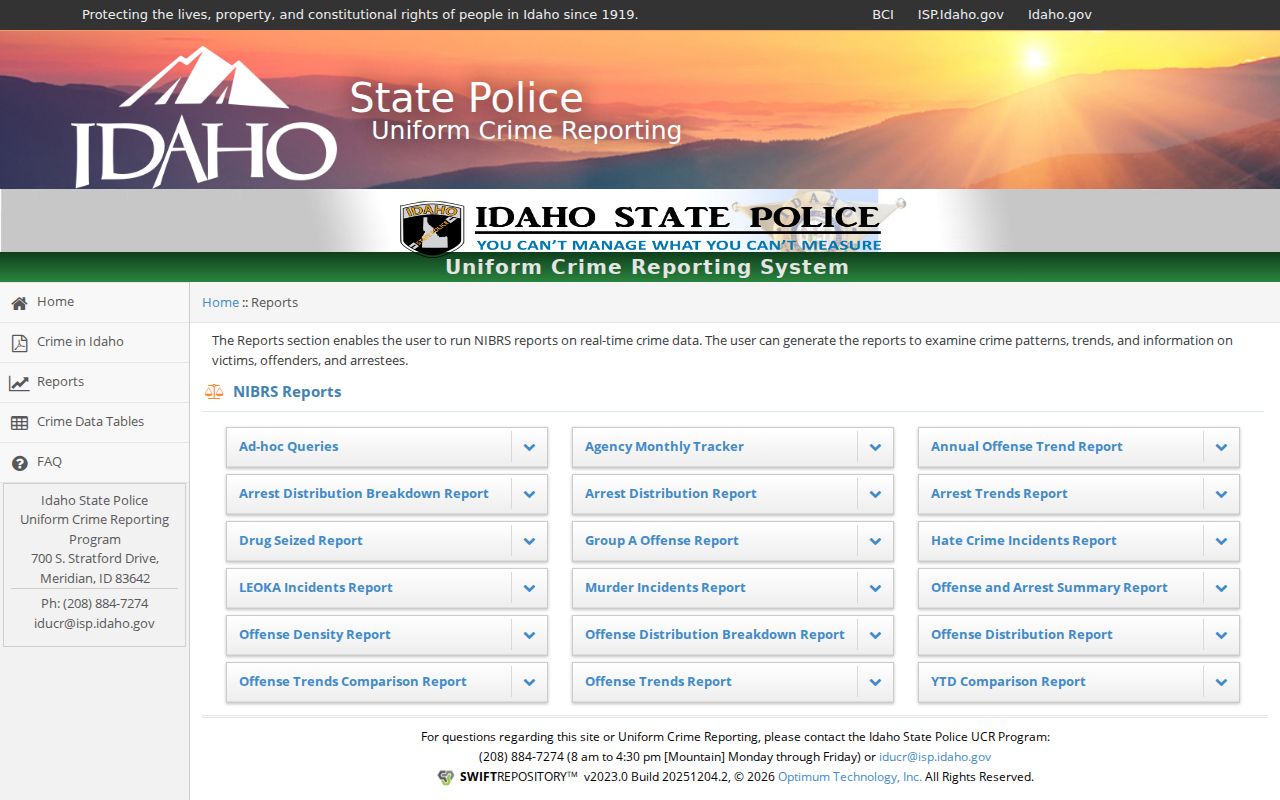
This report center provides aggregate Idaho arrest data, not a name-based arrest history lookup.
Live Idaho figures can change after the frozen annual report because Idaho agencies continue to submit data. The statewide arrest distribution dashboard shows the interactive view.
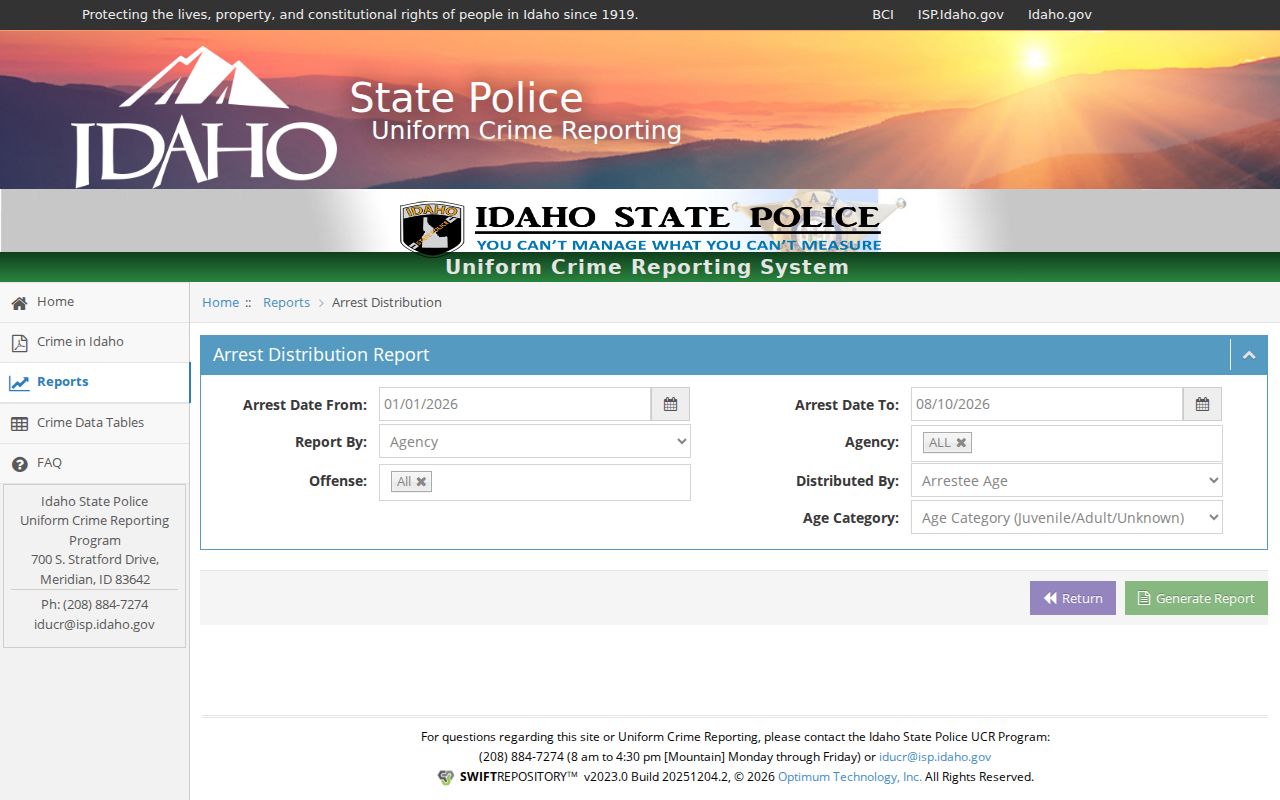
Use its categories as statewide context, then turn to the responsible county or agency for an individual Idaho arrest record.
Idaho Arrest Lookup Options
There is no complete statewide Idaho current-arrest or jail portal. Recent Idaho searches must begin where the arrest likely occurred. Some Idaho counties publish a current roster or arrest list. Others require a phone call, counter visit, or records request. An Idaho no-result can mean release, transfer, a noncustodial citation, another county, or a delay. It does not prove no arrest took place.
- Identify the likely county and arresting agency. Check the sheriff's current booking or jail channel when offered.
- Call the county jail if no online roster exists. Use the full name and approximate booking date.
- Search iCourt for the complaint, initial appearance, charge changes, and disposition. Very new cases can lag.
- Request the incident report from the exact sheriff, police department, tribal agency, campus agency, or ISP custodian that created it.
- For a broad historical Idaho review, order an official BCI name or fingerprint check. Use IDOC only for state custody or felony supervision.
Browse the directory of all 44 Idaho counties to reach the jail, clerk, and local records route for the place involved. The county fallback is essential because a statewide record cannot supply the complete booking sheet or officer narrative.
The BCI name check costs $20 and can be submitted by mail, hand delivery, or fax as the current form permits; the result comes back by mail. The $25 fingerprint check uses a complete applicant card and goes by mail or hand delivery. BCI can roll a card at its headquarters, while residents elsewhere should ask a local law-enforcement agency about fingerprint hours and fees. Neither product is an instant public web search.
Idaho Arrest Report Custodians
ISP's records portal covers only reports and media created by Idaho State Police. The official ISP JustFOIA request system is the state-agency route.
The portal does not replace a county sheriff, city police, or other local custodian when that agency made the arrest.
For one's own Idaho incident, identify the report number, date and approximate time, location, name used at arrest, and requested item. Ask for the Idaho narrative, probable-cause statement, booking sheet, property receipt, or releasable media by name. A focused Idaho request reduces search time and cost. Idaho residents receive the first two labor hours and first 100 paper pages without charge under current Attorney General guidance, while excess work and copies may be billed.
The Idaho Public Records Act permits redaction or withholding of active-investigation facts, juvenile information, victim or witness contact, medical details, security-sensitive material, and data that could hinder enforcement. It does not require an agency to create a new statewide list. Ask for an estimate before broad media work and send the request to the office that already has the record.
Fields on an Idaho Arrest Record
Idaho fields change by source. An Idaho agency report can carry narrative and evidence detail. An Idaho booking record focuses on custody. A BCI cycle ties a fingerprinted event to reported charges and later outcomes. Verify labels before treating two numbers as the same identifier. An Idaho SID belongs to the state repository, a booking number to one jail episode, a court number to one judicial case, and an IDOC number to corrections.
| Name & Identifiers | Name used, aliases or descriptors, with sensitive values restricted by source. |
|---|---|
| Date & Location | Incident, arrest, or booking time and place as recorded by the creator. |
| Arresting Agency | Sheriff, city police, ISP, tribal, campus, or other authorized agency. |
| Charges at Booking | Alleged offenses or holds at intake; charges may change after prosecutor review. |
| Booking Number & Image | Jail episode identifier and photograph when the county lawfully displays or releases it. |
| Bond & Release | Amount, type, conditions, release, transfer, or hold status depending on the jail. |
A probable-cause statement records allegations supporting early process. It is not a trial finding. Booking images must not be treated as proof of guilt, and juvenile arrest material is restricted. No verified Idaho law was found that bars release of every adult booking image in all cases, but each agency must apply exemptions and redactions.
Idaho Jail and IDOC Records
An Idaho county jail holds many people awaiting first appearance or trial, people on warrants or other holds, and some local sentences or state overflow. The Idaho Department of Correction handles state-sentenced residents, retained-jurisdiction riders, parole violators, felony probation and parole, and contract placements. A person under Idaho IDOC jurisdiction can still be physically placed in a county jail or an out-of-state bed. Read both Idaho status and location.
For a new arrest, search or call the county jail first. After state commitment or for felony supervision, use IDOC Resident/Client Search. It updates daily and accepts at least two last-name letters or three IDOC-number digits. Current and former clients can appear. Once a sentence is satisfied, IDOC keeps name and discharged status but removes displayed conviction detail. Federal custody belongs in the BOP locator, not either Idaho system.
The Idaho correctional placement picture can also shift. A 2026 Justice Reinvestment report described a system at 122% of capacity, with more than 1,200 sentenced people in county jails and about 600 out of state. IDOC transferred people to an out-of-state facility in March 2026. Those facts explain why a county roster, an IDOC status, and the person's physical location may not update in one step.
A representative official county pattern appears on the Ada County arrests, inmates, and warrants page.
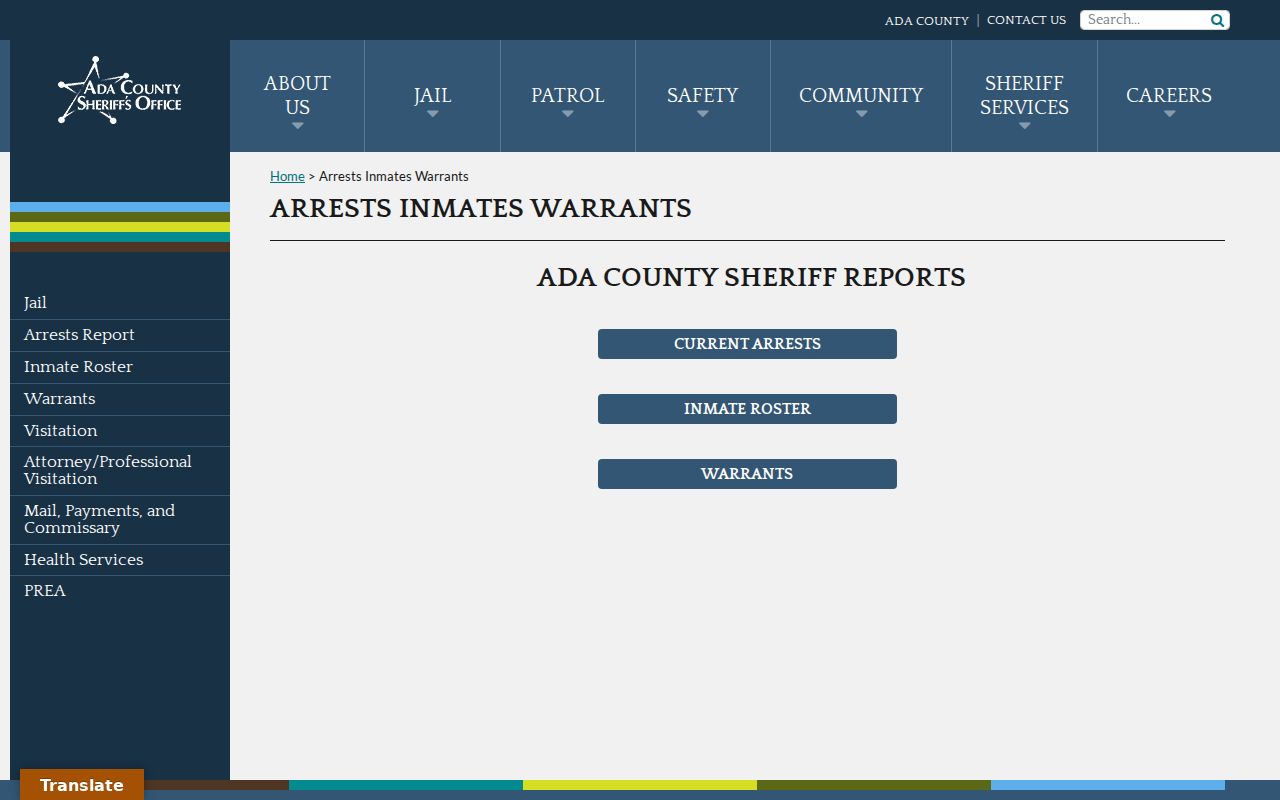
It is one local example, not a statewide booking database; each Idaho county controls its own arrest and jail access method.
Idaho Arrests and Convictions Compared
An Idaho arrest records an accusation or custody event. An Idaho conviction is a court judgment of guilt after a plea or trial. Idaho BCI is event-based, so its history can show a dismissed Idaho arrest with the dismissal noted. An Idaho court result must be read for each charge. One count may be dismissed while another ends in conviction, and the overall Idaho case label may not state that distinction clearly.
| Point | Arrest Record | Conviction Record |
|---|---|---|
| Created by | Arresting agency and county jail; BCI if prints are submitted | Court judgment, then reported toward BCI |
| Meaning | Person was cited or taken into custody on an allegation | Guilt was established by plea or verdict |
| Best source | Agency report, booking record, and BCI cycle | iCourt docket and filing clerk's judgment |
| Relief | Some wholly nonfiled, acquitted, or dismissed events may qualify for BCI expungement | Relief is narrower and depends on the exact Idaho remedy |
Note: An Idaho arrest entry without a disposition is not proof of guilt; confirm every charge with the filing court.
Clearing Some Idaho Arrest Records
Idaho Code section 67-3004(10) provides a specific BCI expungement route for some arrests or criminal summonses. It may apply when no indictment or information was filed within one year, every incident charge was dismissed, or the person was acquitted of all offenses from the event. This is not a general eraser for convictions. A dismissal following a withheld judgment is a different remedy.
For one's own event, first obtain a fingerprint-based BCI record. Then collect reliable court or agency proof, such as the charging document and certified disposition or proof of the nonfiling period. The BCI application asks for identity and contact data, offense and arrest facts, agency, case number, county, charges, and the basis for relief. BCI reviews the written packet. Clean Slate shielding, juvenile expungement, withheld-judgment relief, and a pardon each have different effects.